
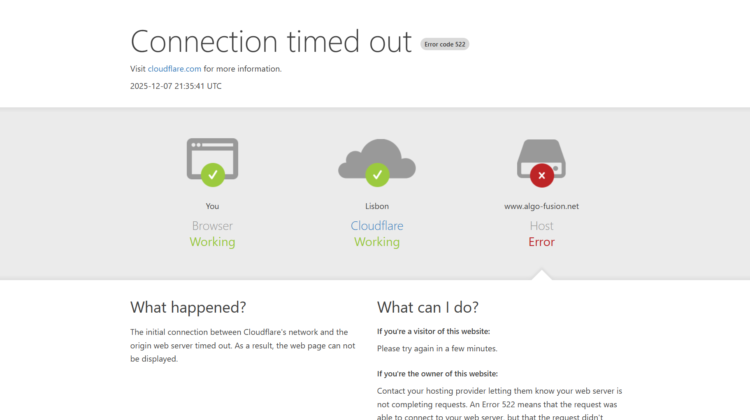
Algo-Fusion.net Scam — Review of a Doubtful Platform
Introduction
In the world of online investments, trading platforms, and algorithm-driven finance tools, every so often a new site emerges promising quick gains, passive income, or access to “exclusive” strategies. Many of these platforms might be legitimate — but some show worrisome patterns that experienced analysts recognize as warning signs. In this review, we use the name “Algo-Fusion.net” as a case study to illustrate what such patterns typically look like, and why they merit scrutiny.
1. A Shiny Exterior — Marketing Meets Obfuscation
At first glance, Algo-Fusion.net presents itself in a polished, professional way. The homepage features dynamic visuals: sleek banners boasting high returns, rotating testimonials with smiling “users,” and big bold claims about “next-generation trading algorithms,” “instant payouts,” or “24/7 profit automation.” It checks all the boxes of what people expect from cutting-edge fintech.
However, when you scroll deeper — or attempt to find specific details — the substance begins to fade:
-
The “How It Works” section uses marketing jargon: “AI-driven trading,” “institutional-grade infrastructure,” “smart liquidity pools,” but offers almost no concrete explanation of the mechanics. There is no whitepaper, no transparent algorithm explanation, no backtesting results, no link to independent audits or third-party verification.
-
Screenshots of dashboards or profit charts are often static — images, not live data. When you hover, click, or attempt to inspect elements, there’s no interactive data feed, no sign of real-time updates, no way to confirm those numbers reflect actual trades or market activity.
-
Promises are broad and sweeping — “consistent monthly yields,” “guaranteed growth,” “low risk/high reward.” Rarely, if ever, does the platform acknowledge the inherent volatility of financial markets, or the possibility of losses.
This mismatch — professional design + vague substance — is often a first warning sign. Slick marketing can be inexpensive; but delivering real, transparent trading infrastructure requires far greater effort. When the latter is missing, design alone becomes a facade.
2. Anonymous or Unverifiable Team — Absence of Accountability
A legitimate financial or trading service typically has a credible team behind it: founders, developers, legal compliance staff, possibly licensed brokers, regulatory disclosures. Transparency about who is behind the platform builds trust — and enables accountability.
In contrast, when evaluating Algo-Fusion.net, a number of observations may raise red flags:
-
The “Team” page, if present, lists a handful of names — but without any verifiable credentials, bios, or links to professional profiles (such as LinkedIn, prior projects, academic or industry history).
-
Some “team photos” may appear generic, stock-photo–like, or seem inconsistent with each other (mismatched backgrounds, lighting, quality). There may be no sign of past track records, company registrations, or regulatory status.
-
The “About Us” or “Our Mission” sections may read like marketing copy, rather than transparent business disclosure: talking of revolutionizing finance, democratizing wealth, or “bringing Wall Street tools to everyday investors,” but giving little detail about compliance, regulation, or legal structure.
Without verifiable people behind the service, there is no way for users to assess integrity, experience, or accountability — a foundational weakness for any platform handling real capital.
3. Unrealistic Promises — High Returns, Low Risk, Zero Transparency
Perhaps the most common red flag across suspicious online platforms is the promise of substantial returns with minimal risk. With Algo-Fusion.net, these promises may take several forms:
-
Claims of fixed or guaranteed returns (e.g., “5–7% monthly returns, no matter the market conditions”).
-
Marketing that downplays or ignores volatility or losses — suggesting the platform’s proprietary algorithms can eliminate or dramatically reduce risk altogether.
-
Frequent use of phrases like “passive income,” “set and forget,” “no trading knowledge needed,” or “just deposit and watch profits grow.”
But financial markets — even the most advanced — are inherently unpredictable. No algorithm, no matter how advanced, can ensure uninterrupted profits with zero drawdowns. Whenever a platform claims otherwise without disclosing strategy, risk model, or safeguards, it should raise skepticism.
Moreover, the lack of transparency about the actual trading strategy — what instruments are traded, how risk is managed, what happens in adverse market conditions — means users are effectively asked to rely solely on blind faith, without data or logic.
4. Opaque Business Model and Circular Logic
One of the most critical aspects of a legitimate platform is a clear, believable, and accountable business model. Users should be able to see how the platform generates revenue, how profits are shared, and how the operations remain sustainable. With algo-fusion, the business model may appear murky or circular:
-
The website might say that profits come from “platform liquidity,” “pooled community investments,” or “algorithmic high-frequency operations,” but does not detail what assets are traded, how liquidity is sourced, or whether there are real counterparties or exchanges involved.
-
Membership or “investment tiers” may be offered — where higher-tier users are promised higher returns, better conditions, “premium algorithm access,” or faster withdrawals. Yet the differentiation between tiers may be vague, and no technical or legal explanation supports why those tiers would deliver better returns.
-
The revenue model might rely on fresh deposits from new participants rather than actual returns from trading — in other words, a structure where returns for earlier users are paid using funds from newer users. If the platform never discloses real trades, assets, or reserves, sustainability becomes questionable.
In such a structure, the platform is less of a service provider and more akin to a speculative ledger: as long as new money keeps coming in, payouts might be possible; once flows slow or reverse, the system becomes fragile.
5. Testimonials and “Success Stories” —
Social proof can be powerful: glowing testimonials, “real user” stories, screenshots of big payouts, before-and-after balance charts. But if those stories lack external verification, they may be manufactured.
With Algo-Fusion.net, warning signs may include:
-
Testimonials with only first names or pseudonyms, no verifiable identity, no links to public profiles.
-
Generic success stories: “I made over 10,000 in a month!”, “Quit my day job thanks to Algo-Fusion.net.” The stories often mirror each other in structure and tone, suggesting a templated or copied format.
-
Payout “proofs” presented as screenshots — easily faked or manipulated — rather than official statements or verifiable transaction logs. Without verification from independent blockchain explorers, bank statements, or third-party audits, these proofs remain anecdotal.
Testimonials alone — especially if unverified — are insufficient evidence of legitimacy. They can be powerful marketing tools, but they shouldn’t replace transparency, documentation, and accountability.
6. Withdrawal Barriers, Hidden Conditions, and Fine Print Surprises
Even if a platform initially allows deposits and early returns, a common pattern among suspicious schemes is to make withdrawal difficult, restrictive, or subject to hidden conditions. Potential warning signs on Algo-Fusion.net include:
-
Requirements to reach high thresholds before withdrawal — often much higher than deposits. For example: “You must accumulate a profit of X% before you can withdraw,” or “Withdrawal only available after holding funds for Y months.”
-
Withdrawal fees or penalties that are vaguely explained, or sudden changes in the fee structure. For example: a “processing fee,” “network fee,” or “premium user tier” fee that appears only when you try to withdraw.
-
“Maintenance periods,” “security upgrades,” or “system migrations” that temporarily block withdrawals, often accompanied by vague promises of transparency later — but with indefinite timelines.
-
Complex identity verification procedures, or demands for additional documentation, often presented late in the process (i.e., after user has invested and wants to cash out), which may discourage or delay actual withdrawals.
A platform that makes it hard to cash out should be viewed with serious caution. If the user cannot exit easily, the risk of getting locked in — regardless of official promises — becomes real.
7. Lack of Independent External Footprint or Regulatory Transparency
Credible trading or financial platforms tend to be visible beyond their own website. There might be news coverage, regulatory disclosures, third-party reviews, discussion on independent forums or communities, user feedback, or some trace of track record. In contrast, a platform like algo-fusion may show:
-
Zero mentions on financial news sites, trading forums, or reputable watchdog databases.
-
No publicly available regulatory registration information, no licensing disclosures, no compliance statements with recognized financial authorities.
-
New or nearly empty social media profiles, often created just when the platform launches, with mostly promotional content and little community interaction or neutral reviews.
-
Absence of independent third-party audits or security assessments, which are common among legitimate firms handling user funds.
This invisibility — especially for a platform claiming to handle real money and complex trades — is highly suspicious. It means there is no outside entity verifying or vouching for the platform’s operations, and no historical footprint to help evaluate claims.
8. Terms & Conditions — Dense, Legalistic, Weighted Toward the Platform
Often, the contract or terms-of-service agreement hides critical details that advantage the platform. For Algo-Fusion.net or similar ventures, the fine print may include:
-
Clauses that allow the platform broad discretion: changing payout rules, suspending accounts, modifying fees at any time, altering withdrawal conditions — without prior notice to users.
-
Jurisdiction and dispute-resolution clauses that favor the company: e.g. forcing arbitration in a location distant from where users are based, under laws that are difficult to enforce.
-
Terms that disclaim liability extensively: stating that the platform is not responsible for market losses, technical issues, “acts of God,” or downtime — giving them near-total immunity in the event of failure.
-
Opaque or hidden privacy and data-use policies — allowing the platform to use, share, or monetize personal or financial data without clear consent.
Such contractual power asymmetry puts the user at a serious disadvantage. When you combine that with the other red flags — opaque model, unverifiable team, high-pressure marketing — the legal fine print ceases to be a neutral formality and becomes a potential trap.
9. A Combined Pattern — When Multiple Warning Signs Align
Individually, some of these issues might be explainable. A young startup might not yet have broad media coverage; many legitimate firms use stock images for placeholders; some small platforms offer high returns with proprietary strategies. But when multiple warning signs appear together — as is often the case with algo-fusion–type platforms — the pattern becomes hard to ignore:
-
Professional-looking website but no transparent technical details
-
Unverifiable or anonymous team
-
Promises of high returns with low risk
-
Heavy marketing pressure and referral incentives
-
Testimonials without verification
-
Hidden or harsh withdrawal conditions
-
Lack of independent presence or regulatory compliance
-
Onerous legal terms favoring the platform
When all these factors coincide, the likelihood that the platform may not be long-term sustainable — or may never have been genuine — significantly increases
Conclusion: Report Algo-Fusion.net Scam to AZCANELIMITED.COM?
Based on all available data and warning signs, Algo-Fusion.net raises multiple red flags that strongly suggest it may be a scam. From its unregulated status to its anonymous ownership and unrealistic promises, this platform lacks the transparency and trustworthiness expected from a legitimate financial service provider.
REPORT THIS PLATFORM TO AZCANELIMITED.COM
If you’re thinking of investing through Algo-Fusion.net , extreme caution is advised.
